Showing posts with label movies. Show all posts

Monday, December 28, 2009

One-Dimension in Three-Dimensions


Over the weekend our oldest two kids cajoled us into going to see James Cameron’s latest creation “Avatar”. I had planned on just passing this one over because the plot that I could work out from the trailers looked rather lame. I was convinced to go see it when several people that I trust informed me that the imagery in the film was nothing short of stunning and it would be worth my money to see it in the theatre. So here is a quick review of the movie.
Warning! There will be some spoilers.

First the good news:
As predicted the imagery was breathtaking. The CGI and the 3-D effects created a very believable and beautiful world. The variety of Pandoran landscapes and wildlife were so well done that it reminded me of a National Geographic Imax movie. Only on a few rare occasions did the graphics betray its CGI roots. This is clearly the crowning accomplishment of this movie. If for no other reason the movie is well worth the price of admission.

Now the bad news:
There really is no other reason to see this movie besides the graphics and the eye-candy I’ve already described.
The characters are profoundly one-dimensional, particularly the villains. Every preconception you make about every character turns out to be right on the money.
The plot has been recycled so many times that it is easily predictable. The story just seemed to drag along while you were waiting for the inevitable to occur. One friend of mine called it “Dances with Space Wolves”. The story follows a very similar structure. It’s hard to escape the parallel. The overdubbing, the journal entries, etc. It’s as if he just borrowed Costner’s storyboard for the first two hours of the movie.
Although I share their views, the heavy-handed environmental message was laughable in its rigid adherence to stereotype. The good guys were a bunch of self confessed tree-huggers looking for the life force of the forest and the bad guys were the mindless corporate drones driving fleets of bulldozers side by side in formation across the wilderness in order to meet a self imposed production deadline. Another friend of mine called the movie “a half billion dollar CGI remake of ‘Fern Gully’”.
I also had a hard time with the technological anachronisms in the movie. The humans had perfected near light-speed travel yet their military hardware was little more than Blackhawks with modified rotors. They had developed a way to clone human alien hybrids and transfer their thoughts from a “driver” to the hybrid, yet they still fought their battles hand to hand with flesh and blood soldiers in the field. Why? Even the bulldozers in the movie were remote controlled. So why risk the soldiers?
I really wish Cameron would hire a screenwriter for his next film. “The Abyss” was great. But ever since then he has been willing to sacrifice plot, dialogue, character definition and every other element that makes a movie great in exchange for magnificent images. Make no mistake; the images in “Avatar” are amazing. It just saddens me to see this much money spent on creating stunning three-dimensional images to tell a tired one-dimensional story.

Monday, May 18, 2009

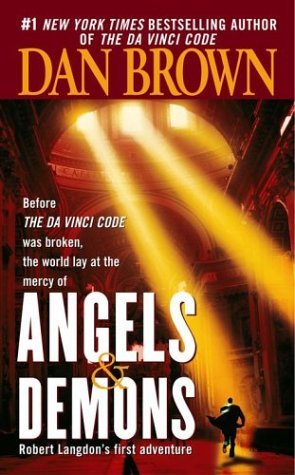
Angels and Demons

As most of my readers will know, I really enjoy exploring issues of science, politics and religion. I particularly enjoy looking into where they overlap. Some of the best books I have read are on exactly this subject. Whether fiction or non-fiction I enjoy seeing how different characters balance these sometimes conflicting priorities in their lives.
With this in mind I was really apprehensive about Ron Howard’s film adaptation of Dan Brown’s book Angels and Demons. The book was very well done and I thoroughly enjoyed it. It seemed that each and every character in the book had a slightly different way of balancing science and religion in their lives. New details that were revealed in the process of the story unfolding forced these characters to have to reevaluate their decisions. How each of those characters responded to this problem was what gave depth and reality to the book. It was a very cerebral book.
As many others have pointed out, Brown does take a very liberal interpretation of what he refers to as facts. As he did in The DaVinci Code and all of his books he frequently twists the facts a little to make the codes and mysteries in his story work. I don’t really have a problem with this as long as he doesn’t claim that those details are facts. Brown does claim that those details are facts and it gets the church and others outraged and just draws publicity to the book. I enjoyed his books as fiction and something to provoke thought and further research but they are fiction so I’m not going to get too hung up on those details.
Anyway, I was apprehensive about seeing the movie because I really was unimpressed with Howard’s interpretation of The Davinci Code. Now I’m not one of those who gets all upset just because every detail and nuance of a book that takes days to read isn’t spelled out in a two hour movie. I understand the differences and the strengths of both mediums and I enjoy them both. Although I typically enjoy reading the book better than the movie I have seen a few movie versions that I enjoyed even better than the books. Jurassic Park and Contact are the first two that come to mind.
I just thought that Howard left out far too much of Angels and Demons. The depth of each character in the book was defined by how they responded to their internal conflict regarding the balance of science and religion. The movie avoided this conflict completely with most characters and only hinted at it with one or two. Sure the chase through Rome to find the killer was a good action story but without the internal struggles of the main characters you didn’t understand or even care why the chase was important. One of the main characters in the book was a prominent scientist who you suspected may have even been the one behind the murders was left out of the movie all together. His internal struggle and ultimately his decision to assist the church was one of the more dramatic character conflicts in the book. I have no idea why he was wholesale written out of the movie as well as nearly all of the other character’s internal struggles.
In the movie and in the book you really grow to love one character who comes across very likable and reasonable. At the end of the book his positive attributes are rewarded. However in the movie adaptation this character does not get the same reward. I can see no reason at all to make this change in the movie. It would have cost no extra film time and would have been a nice way to reward a likable character.
I've seen a few book to movie conversions where I liked the movie much better. This just wasn't one of them. I wish I’d have waited for the DVD.

Thursday, April 30, 2009

The Men Who Stare at Goats

A few months ago I listened to an interview with the author Jon Ronson about his new documentary book The Men Who Stare at Goats. The interview was very lighthearted and so I thought the book would be a fun read. As I read one chapter after another what started out as a lighthearted view of some of the silly stuff that our tax dollars have paid for soon turned into a very disturbing expose’ of the insanity that goes on under the moniker of Special Ops.
The book is a story about Ronson’s investigation of the US military’s experiments on all sorts of pseudoscientific projects. Soon after Vietnam the military began to reconsider much of its fighting strategy. Nothing was taken off of the table. With the assistance of a few men with some downright crazy ideas they began to serious talk about the formation of a special ops battalion that had Jedi powers. They even referred to themselves as warrior monks and honestly believed that they could psychically influence their enemies to surrender just by using their mind, comforting colors and subliminal sounds. The most advanced of these “warrior monks” believed they could literally walk through walls and psychically stop the heart of an enemy just by concentrating hard enough, hence the title of the book. Ronson spent two years trying to track down the one guy who he was told had actually killed a goat by starring at it only to find out that the best he could do was to make a hamster behave oddly.
These chapters were funny and a little bit amusing. The later chapters took a far more serious tone. Rosnon shows that many of the very same people who thought they could star a goat to death were also behind a group that thought they could remote view, or psychically project their vision and get advance intelligence. One of these “viewers” left the military and started predicting all sorts of prophecies on am radio shows. Eventually one of his failed predictions led to the mass suicides of the members of the Heaven’s Gate cult.
Some of the more perverse of these psychic techniques were adapted by the more mainstream military and intelligence departments. Ronson interviews a British citizen who was captured by the US military and subjected to all sorts of torture and abuse for two years while he was held captive at Guantanamo Bay. Ronson was able to show a pretty convincing link between these activities and some of the original proposals set forth when they tried to for the battalion of “warrior monks”.
In the process of doing some background research and fact checking the book I noticed that this book is being made into a movie staring Ewan McGregor and George Clooney. The movie is billed as a comedy. It’d have to be a very dark comedy. Also none of the names of characters match the real people named in the book. I can only assume that the names were changed for the movie or that the movie will be only loosely based on the book.
My biggest criticism of the book was its lack of footnotes and sources. I have a big bias towards heavily footnoted books.
I have a big problem with people and organizations that don’t base their actions and opinions on facts and reason. This book is a bright light on those in the US Military who wish to wage war based on illogic, superstition and magical thinking.

Saturday, May 10, 2008

Monday, April 16, 2007

Mormon Cinema update

Several months ago I wrote a little essay/ vent about the current condition of Mormon Cinema. Please take a few minutes to read it if you haven’t already. Church Ball and the Death of Mormon Cinema

Well now it seems that the very director I was quoting as the only one with any vision at all for the genre’ has decided to leave the very genre’ that he essentially founded. Please read Richard Dutcher’s “parting words to Mormon Cinema."

If I were a more cynical man it would be easy for me to jump up on a soapbox and say, “See I told you so.” However I’m far too saddened by these events to do that. The truth is I was hoping that somebody would rescue the genre’ and prove my musings to be too pessimistic.

Dutcher phrased it much better than I could. However we both identified the root of the problem as film makers relying on LDS members to support the films simply because they were LDS films. As long as these film makers continue to rely on the charity of members for their support they are no better than the government funded artists who sell painters drop cloths as art and make million of dollars for something that blownotherwise would have gone to the garbage bin.

I will continue to hold out hope for the eventual survival of Mormon cinema. I‘m just not sure where to look now that its brightest candle has been extinguished by mediocrity and ambivalence.