Thursday, January 31, 2008

Noahisms

All my kids are weird. But Noah is like weird2. So Victoria is helping him with his homework and he comes to this question, "Name something that is cone shaped". And how does Noah respond? a nosecone for a rocket? a birthday hat? a funnel? No not Noah. He says, "My underwear, when I fold it in a cone shape."

Wednesday, January 30, 2008

More on Podcasts


My mother-in-law gave me a cool little MP3 player for Christmas. Thank you, Sue. Since I've given up talk radio I've been listening to a lot of books on tape and podcasts for the past year. Without an MP3 player I've just been setting up my laptop at work and listening that way. With my new player however, I can listen much more than I used to. I can take it on my walks on my lunch hour; I can listen in the car; and I don't have to pause it while I walk back and forth to the printer and the break room. You get the idea.
I've found that there are a bunch of books that I can download directly from the library in MP3. That's been a great resource. I recently listened to Thoreau’s Walden. The irony of listening to Walden on an MP3 player while I stare at a drafting program while designing a fiber optic based high speed data circuit for American Express was not lost. It actually helped me stay sane during the process.
There are several weekly podcast that I eagerly await the next episode so I can download and learn more. Lately my new favorite is Astronomy Cast. Each episode is remarkably simple yet very intriguing. It's just the host, Fraser Cain, the publisher of Universe Today talking with an astronomy professor, Dr. Pamela Gay. Fraser typically steers the conversation by asking tough questions and then just let's Pamela give a very thorough answer. I'm sure Fraser actually has much more knowledge on the subject than he let's on to. But he plays the role of an amateur very well. His questions and responses are right in line with what an average college student might ask on each subject. Listening to Astronomy Cast is very much like sitting in an ASTR 101 class and just listening to that one guy who likes to ask all the questions that you'd have asked. I'd recommend it to anyone as a companion to an astronomy class or just if you think astronomy is cool and would like to know a little more. Fraser lives in Canada so it's kinda funny to hear the way he pronounces "about". Being from the South, I'm sure he'd get a kick out of how I pronounce some words too.
SETI has a very interesting podcast that I also enjoy. It's very professionally mixed and edited and has the feel of an PBS documentary. They explore much more than the typical astronomy topics. Many of their episodes detail the scientific method and how we've learned what we know about the universe.
My old standby is The Skeptic's Guide to the Universe. Dr. Steven Novella hosts a well informed group of "skeptical rouges" on discussions of current events. Whether it's UFOs over Texas, ghosts in gas stations or the latest panic about Autism, I've really grow to trust the fact based, logical advice given on this podcast.
Recently I've also been downloading podcasts that have been reference on NPR. Electrons to Enlightenment explores the intersection of science and theology. It's only a four part series but I'd love to see it expanded into a weekly podcast.
Speaking of Faith is a program that my mother-in-law recommended because of a program they did on Mormonism. I downloaded that episode and several others. I'll review them more in detail after I've listened to a few more episodes.
I'd like to find more podcast out there that explore religion, science and politics as well as the complex interplay of the three. With all of this very intriguing material now filling my MP3 player I don't see how I could ever find the time to listen to the monotony of talk radio again even if I wanted to. Given the choice between learning something new about our universe like how we're finding extra-solar planets or just hearing some pundit recycle Clinton jokes, I don't have to think very long to figure out which would be a better use of my time.

Monday, January 28, 2008

Cemeteries


A few years ago I was up in Utah for my Grandmother's funeral. While there I took a trip to the Salt Lake City cemetery to do some genealogy research. I found quite a few family head stones and also quite a few headstones for prominent figures in LDS history. I'm not freaked out by cemeteries. On the contrary, I think they are cool. It intrigues me to think of the history that is quite literally just under my feet.
Of all the tombstones I saw that day only one made me sad. It was the headstone for Marjorie Hinkley, the wife of Gordon B. Hinkley. The stone had both of their names on it and it was a little uncomfortable to see the name of a living person on a tombstone. It saddened me think of the two of them being separated after having spent so much of their life together. I know it's kinda weird to think this way, but my heart was gladdened by the news this morning that these two are separate no longer.
So long. I'll miss your leadership and sense of humor but I'm glad that you are once again with your sweetheart.

Sunday, January 27, 2008

Pascal's Wager

When the philosopher Blaise Pascal was asked why he believed in God in spite of the evidence, Pascal gave what has since been referred to as Pascal's Wager. Pascal argued that in spite of the lack of evidence for the existence of God, the potential negative effects of the decision, eternal damnation, caused him to be a Christian. He argued that since living as a believer was a pretty good way to live even if there really were no God. Modern philosophers have restated Pascal's wager into what they call the precautionary principle. “…if an action or policy might cause severe or irreversible harm to the public, in the absence of a scientific consensus that harm would not ensue, the burden of proof falls on those who would advocate taking the action.”
This is just a way of shifting the burden of proof from one side of the issue to the other. Suppose my family is stuck on a two lane road behind a car going 10 miles below the speed limit. If my son tells me I should pass the car in front of us because there hasn't been a car in the other lane for 10 minute. He may indeed be correct. However, lacking more solid evidence to support his claim that the lane is clear the safest choice is to remain in my lane.
Whenever I hear naysayers criticize the scientific consensus as it pertains to global warming I think about Pascal's wager and this example that I gave. These so called Global Warming "skeptics" cling to a few fringe pieces of evidence and claim that global warming is not happening and that it's perfectly okay to drive in the other lane for a while. And the truth is they may be correct. But considering the dire consequences of this decision Pascal and the precautionary principle dictate that we should consider the potential effects of each decision and give these effects due consideration when making our choice.
I realize that taken to extremes this line of thinking is somewhat fallacious. I'm not condoning this thinking in every situation. If I did I'd end up wearing a tin-foil hat just in case Art Bell is right about aliens controlling our brain waves. Specifically in the case of global warming I just don't think that a few outlying studies support the idea that we chuck the rest of the evidence.

Thursday, January 24, 2008

Snow


So what do "normal" people do on a Friday night when there are winter weather advisories? In Georgia the trend seems to be to panic and run to the grocery store as if snow in Georgia were one of the first horsemen of the apocalypse and somehow having a pantry full of bread and fresh milk in the fridge will allow the destroying angel to pass over your house.
Well I wasn't about to have any of that. Instead I went ahead with our normal plans for a Boy Scout backpacking trip that we'd planned weeks ago. Earlier in the week, when I realized that the weather was gonna be rough I sent out an email warning everybody that I had no plans to cancel just because of a little snow.
We hiked to the top of Tray Mountain on the Appalachian Trail. Since we have to leave after the boys get out of school we didn't start hiking until it was dark. But the snow on the ground reflected enough light that we didn't need to use any flashlights for the hike up. We set up camp on a few inches of snow on the summit.
Saturday morning we packed up and started hiking back. Soon the snow just started coming down. It was interesting hiking out. Over the past week the ice that had formed on the branches of the trees had fallen and it felt like we were walking on piles of batteries of all different sizes. By the time we got back to the car the snow had piled up several inches on everybody's head and shoulders.
The drive back down was a little dicey. The roads had built up a fair amount of icy spots. But we all made it home safely and had some great stories to share. All of the boys who went said it was their first time hiking and camping in the snow. I'm glad they all paid attention at our recent, "How to stay warm" clinic.

Friday, January 18, 2008

SHAM

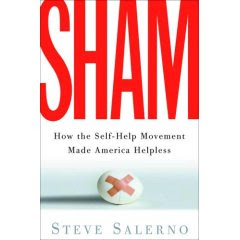
Why are Americans so dysfunctional? You'd think with the thousands of books, radio show, and TV programs that try to teach us how to help ourselves become better people that eventually we would start to show some signs of progress. But where is the progress? In Sham: How the Self-Help Movement Made America Helpless Steve Salerno makes a very compelling case that the self help actualization movement, SHAM, is actually causing America to be more dysfunctional.
Think about this for a second. What do these people all have in common; Laura Schlesinger, Phil McGraw, Tony Robbins, and John Gray? Well for starters all four have written books on how to have happy marriages and they've condemned extra-marital affairs. All four are also guilty of the behaviors that they preach against. Salerno goes into extensive detail into every major player in this movement. Far from just being a series of ad hominem attacks, Salerno shows considerable evidence that these gurus have no desire to practice what they preach. They simply want to make themselves rich by pontificating their opinions to anybody who will listen. The multitude of other would be gurus are waiting for the Midas touch of SHAM endorsements in order to make it big; a mention or appearance with the career-make herself, Oprah.
Salerno's most damning evidence that SHAM is exactly that, a sham, comes from his own experience working in the publishing industry. He found research that determined the most likely person to buy a new book in this genre' is somebody who had bought a similar book in the last few months. This begs the question; if the previous book was so effective then why do they need another? And another? And another? This is truly an industry that depends on repeat customers. Advice, advice and more advice yet nobody ever gets healed.
I've never quite understood continuing to pay for a complete lack of results. Why do we accept a lack of result in some businesses and excuse it in others? If I took my truck into the shop because it didn't start and they took my money and gave it back and it still didn't start I'd pitch a fit to get my money back and find another shop. However, if somebody buys a book that "guarantees" a happy marriage, weight loss, or balanced chakras Americans seem to just keep going back to the same gurus, throwing money at them and in the end just getting further and further from the stated goals of the books they are buying. Why? I just don't understand.
We live in a world where people accept Jerry McCarthy's "mommy instinct" over overwhelming scientific evidence that vaccinations do not cause autism, Laura Schlesinger’s advice to stay close to your family even though her own mother was dead and decaying at home for weeks before Schlesinger even found out, Tony Robbins’ advice on how to have a happy marriage that was published while he was having an extra-marital affair and divorcing his wife, etc. etc. etc.
Personally I think that the whole concept of this genre' is based in selfishness. Most of the books are about "me". What do "I" deserve? What's wrong with "me". How can "I" fix this? This whole concept seems counter-intuitive to me. I usually feel better when I'm not so focused on myself. Next time you feel like you need a self-help book go out and do something for somebody else. Go give blood, volunteer to read to kids at a local elementary school, bake some cookies for the neighbors, buy lunch for a coworker, find a charity that you can spend a little time helping out. This is just my advice but it has worked well for me. Hey maybe I could get a book deal out of this.
This book is a bright spotlight that has lit up an industry that has been operating in relative shadows for far too long. It's about time that we started demanding results from this product. And if we don't get the promised results we should find somewhere else to get our advice.
Tuesday, January 15, 2008

A Good Argument

Born Spellers?


I love Arthur. For those of you who don’t have kids I’ll give you a quick introduction. Arthur is an animated Aardvark who has his own kids show on PBS. The characters were created by Marc Brown. The plot lines have some very deep and surprisingly sophisticated themes.
One of the chapters of Mistakes Were Made deals with the drastically different approaches that Americans and Asian cultures take on the issue of making mistakes in school. In American schools there seems to be a theme that certain people are born better at one subject than others. If they don’t excel in that subject rather than being asked to apply themselves and devote a little more effort on homework they are told things like maybe “this just isn’t your thing.” Performance and lack of performance is blamed on inherited ability or the lack thereof. The side effect of this is that by linking it to innate ability the student doesn’t have to feel too bad about not excelling in that subject. Unfortunately, the opposite is also true. When students succeed they are denied the right to take credit for their accomplishments. What is there to take credit for if you didn’t have to do anything to achieve it? I might as well just be proud of my accomplishment of having blue eyes. That’s another genetic trait that I had nothing to do with.
Conversely, Asian cultures and encouraged to tough it out and work through problems in all subjects. Mistakes are not viewed as failures until you quit trying. Perhaps this attitude explains why Asian and Middle Eastern cultures do so much better that Americans in math and science; not because it’s genetic but that they just work harder because they know it is within their control. True the stigma of failure may be strong in those cultures but the joy of success if proportionally greater.
So I’m listening to the current episode of Arthur while I check my email. I’m not listening too intently until I hear the line, “Don’t worry Arthur. Some people are just born good spellers.”
Knowing how well Marc Brown weaves deeper philosophical themes into his stories I turned around and watched the rest of the show. Arthur was studying for a spelling-bee. Just as I suspected Mr. Ratburn, Arthur’s science teacher, took a more Asian philosophy to learning. He encouraged Arthur to enter the spelling-bee because it was hard for him. He empowered Arthur to not be afraid of mistakes and to just keep trying. Later on Arthur’s sister, DW, used the line, “Sorry. Arthur can’t come out to play. He’s exercising his brain.”
Arthur’s brain exercises paid off when it came time for the spelling-bee, in spite of his earlier advice that he may not have been a “born speller”.
This is one of the most powerful lessons that I learned from Mistakes Were Made. I’d like to thank Arthur and Marc Brown for reinforcing this idea with my family.

Appeal to Popularity

Appeal to popularity is a logical fallacy that involves essentially taking a vote to decide the nature of reality. Let's say I decide that the world is flat and we put it up to a vote. 90% of those polled think it is round and 10% think it is flat. Since this "vote" turned out to be in line with the evidence it is easy to assume that the logic is correct. The fallacy is that what people believe is completely irrelevant to the truth. If someone had put the same question to a vote 3000 years ago and the percentages were reversed does that mean the world was actually flat back then? Of course not. Granted this is an absurd example but I offer it only to demonstrate the illogic of the reasoning. In the Republican debates that question was asked about which candidates accepted the theory of evolution. Only about half of the candidates raised their hands. Many interpret this "vote" as evidence that Intelligent Design is just as valid a scientific theory as Evolution. Preposterous.
I've also noticed that people tend to interpret the proportion of media coverage on an event or opinions as some kind of marker as to the validity of that opinion or idea. Suppose a TV channel decided to air a documentary on the JFK assassination and they gave 95% of the coverage in support of the various conspiracy theories and then gave the token skeptical opinion only 5% of the air time. This does not mean that their is any validity to the conspiracy theory at all. It just means that that's what the station choose to give the air time.
I have a friend who gets all of his news from conservative talk radio and foxnews.com. He is always forwarding me the latest report that global warming is a hoax. Since all of the reports that he reads dismiss global warming he tends to think that the whole thing is a hoax. The evidence, ALL of the evidence should be weighted and analyzed to see what the real effects are.
Another flaw in this type of logic is to assume that every person's opinion is equally valid. Not so. If Sean Hannity, Pat Robertson and Steven Hawking have a vote on whether the universe is 8000 years old or not, should we give each of them an equal vote? Of course not.
In my "quest for truth" I have been surprised at what I thought I knew. Once I came to realize the logical hopscotch I was having to play in order to justify my opinions I became very aware of just how ignorant I actually was. In many ways I don't think I'm much closer to the truth, however I am more confident that at least my opinions and the facts that I accept are based on sound evidence.

Sunday, January 13, 2008

Philosopher "Football"

How can you go wrong when you mix soccer, philosophy and Monty Python?