Showing posts with label introspection. Show all posts

Thursday, March 08, 2012

Memories

Returning to a common theme I’ve touched on a few times before.
I was listening to a podcast today. This is a relatively new one but I’ve come to trust the host by some of his previous work. At one point in the show the hosts go on a tangent and start talking about nicknames. The begin to talk about derogatory nicknames that they had for people and then wonder about what similar nicknames they were called behind their backs. I found the bit rather insightful. It invited introspection. What kind of a person do others think I am? It’s always good to reevaluate if you really are the type of person you want to be.
Something about the bit troubled me. It wasn’t until the program was over that I made the connection. The host told about how he used to call one of his junior high school teachers “Jabba the Hutt” and how bad he felt about it now that he looks back on it. Now here’s the problem. The host also revealed in the same episode that he is 56 years-old. So lets do a little math here. If he’s 56 in 2012 then he would have been 21 when the first Star Wars movie came out. But we never saw the character, Jabba the Hutt until Return of the Jedi which came out in 1983, when the host was 27 years-old.
Now I don’t doubt that the host called his teacher a derogatory name. And I don’t doubt his sincerity when he talks about how bad he feels decades later. This story just proves how plastic our memories really are. This event could not have played out the way he remembers it. At the very least the nickname in his memory morphed to accommodate the image he had of that teacher once he saw the movie in 1983.
I’ve talked before about how I’ve been guilty of this same type of memory error. It’s disconcerting to realize that our memories aren’t quite the “dash camera” that we like to think they are.

Tuesday, October 04, 2011

The King Swing

(Warning!! This post is of a very personal nature and may offend some readers.)
This is a video from a very popular rock climbing route in Yosemite. This technique is called a pendulum traverse. Climbers call it "The King Swing” and it takes place on a route called “The Nose” on the 3000’ feature called El Capitan. About halfway up this particular route the cracks and features kind of peter out once you get to the top of that flake the photographer is standing on. Since the rock doesn’t have any little cracks or bumps there is subsequently nothing to pull up on or stand on. Therefore, no way to climb it. The only solution is to go back down and see if you can find another path. Sometimes you see another path but there really isn’t any way to get to it from underneath. The only feasible solution is to do a pendulum traverse. Just as the name implies you lower down as far as you have to and swing back and forth until you can grab a section of rock that is will allow you to climb it.

I’ve done several pendulum traverses, although not this one. They can be quite intimidating. Sometimes you’re not quite sure if you’re swinging into a section that will be just as unclimbable as where you were. One time it was an emergency situation and this was the safest technique to get off the rock during a thunderstorm. But every time I was more than a little apprehensive. The technique requires much more planning than it appears and things have to be done just right in order to stay safe.

Even though the route ahead seems insurmountable it’s quite a weird feeling to hang your butt on the end of a rope and run back and forth hoping to grasp something better, something that will allow you to keep progressing. It’s not exactly the safest thing to do. The times I’ve done them were only in situations where I was absolutely sure that it was the only way to keep on progressing. The risks can be high, but the rewards can be even greater if this leads you to better climbing or a way out of the current predicament.

I’m at a point in my life where I need to take the King Swing. I’ve been on a path that has provided me with much joy and happiness up to this point. I felt like I was growing, learning and progressing. But for the last several years I’ve been stuck on a ledge looking for ways to keep moving up and not finding anything to hang on to. It has taken me quite a while to even consider looking for another path. I’d been raised to believe that the path I was on was perfect and there was no reason to stray from it. But I just couldn’t see where or how to continue. Consequently, I’ve lowered down a little bit and begun to swing back and forth looking for another path.

I believe I’ve found a path. I’m not quite sure how good the climbing will be over there but I’m sure it is more promising than where I am now. Who knows? This new path may lead me back onto my original path from a different angle. Or I may end up having to lower back down this new route too and look for yet another path. I just don’t know right now.

To those of you who aren’t having any problems negotiating the blank sections of the original route, I have no criticism at all. Congratulations. You are better skilled at finding the route than I am. Simply because I am looking for a different path I have no criticism at all if you are making it work for you.

I’m not suggesting that anybody take the steps that I about to without doing at least as much thorough research, soul-searching and earnestly looking for all of the answers. This decision, to take the swing, has not be reached casually. In my case it has been years and years of agonizing study and prayer that has brought me to when I am now.

It’s time to set the metaphor aside. This post has nothing to do with rock climbing. I’m talking about my membership in The Church of Jesus Christ of Latter-Day Saints. For the past several years I’ve been stuck on a ledge and could find no way to keep moving forward. I’ve discussed some of the specifics on this blog numerous times, but I don’t wish to get into them today. To my friends and family who are members of the church I hope that you will take this with the spirit with which it is intended. I am very grateful that you are in my life and I mean absolutely no disrespect to you at all. I have never felt that absolute agreement on everything was necessary for me to love you and this decision will not stop that. I hope that you can see it in your heart to still love me. The most apprehensive part of this decision has been the considering, reconsidering and re-reconsidering the effects it will have on my family.

I fully expect that many of you will not understand my decision. I’m under no delusion that this will be easy. But I believe it will be better in the long run. I’ve seen other friends and family members struggle with some of the same issues that I have. It’s been very selfish of me to let them struggle alone while I conceal my struggles and go through some of the same things they have been.

I am grateful for everything that I have learned so far on my path. Please don’t think that I am going to consider abandoning all of the progress and the good things that I’ve learned in the process. I have no plans to start stopping by liquor stores or breaking any other of the moral and ethical codes the church has taught me. Quite the opposite; I cherish those values and I look forward to continuing to incorporate them into my life.

The private answers to the questions I have asked in my prayers have led me in an unexpected direction, a spiritual path which, at least for now, has proven incompatible with Mormon doctrine. This search for a new route has brought me some of the most profound surprises and also the deepest sadness of my life. It is very hard for me to leave a path that I love so much.

Thursday, June 23, 2011

Conflicts

Many years ago I played saxophone in my middle school band. I wasn’t very good at all. Typically I was either 3rd or 4th chair. That depended entirely on how many saxophones there were that semester, 3 or 4. In band if you wanted a promotion to a higher chair you had to “challenge” the chair in front of you. Friday’s were challenge days. We would go around the band and listen to each challenge. Typically the 2 players would each play the same piece and they were judged by the band director. If that challenger played it better they advanced to that chair. Sometimes challenges would be issued to show an expertise in a specific technique. I remember challenges issues entirely on breathing at the correct spots in a piece.

I will always remember one particular challenge. I was in the flute section. Our band director had been working with us on keeping our fingers close to the keys; basically not wasting energy and time by completely straightening your fingers when a smaller motion will get the job done. So the 3rd chair recognizes that she had an advantage in this area and challenges the 2nd chair to a piece. Here’s where it got interesting. She challenged him based on two criteria, accuracy and keeping fingers on the keys. Both musicians played the piece and then the director had to make a decision. The 3rd chair flutist clearly had mastered the concept of keeping her fingers near the keys. However the 2nd chair played the piece with more accuracy. So what do you do? Which of the 2 challenge criteria trumps the other? Without any ground rules in place before the challenge he decided that a tie meant no change in the positions.

No you’ve probably already realized that this post isn’t really about who sits where in a middle school band class. At our company we have a long standing safety creed. Until a few years ago it read,
“No job is so important and no service is so urgent that we can not take time to perform our work safely."
I have no problem with that at all. It’s simple and to the point. When I would get spot checked while on site my supervisor would ask me what it meant in my own words. I would typically say something like, “It’s just your phone or your internet. Nobody should have to get hurt to make this work.”
Well a few years ago we were bought out by a larger company. And that company made a slight change to the safety creed. It now reads,
“No job is so important and no service is so urgent that we can not take time to perform our work safely and in an environmentally responsible manner."
Hmmm. Now like our band director I am presented with a possible conflict. I have no problem with either of the goals expressed in this creed as long as they don’t conflict with each other. But what about when they do conflict? I can think of several cases where the most environmentally responsible thing to do would not be the safest thing to do in the short term. What if a coworker is being attacked by a Canada Goose? Whose side do I take? The coworker’s or the threatened migratory bird? While I have no criticism of either goal, I just think that bringing up environmental issues in the context of a safety creed waters down the creed and could actually make a situation more dangerous.
Now on to other issues. How many times do we find ourselves in situations like this? Do I swerve to miss the animal in the road and endanger my passengers in the process? Or make a professional decision without considering the family? I guess my only point is that you need to be clear which goal would trump the other before you get into that situation.

Thursday, April 07, 2011

Awe


I've posted this before but I just felt like posting it again today.

Monday, February 28, 2011

Semantics

A few years ago I was having a theological discussion with a friend of mine. He was really impressed that the English word son and sun were homophones. It really appealed to him that Christ, the son, brought light into the world and Sol, the sun, also brought light to the world. Now I realize that this wasn’t the format for textual criticism so I just bit my tongue. I was tempted to point out that the significance of his revelation only applied to English. I didn’t know for sure but I was pretty sure that son and sun were not homophones in the original Greek or Hebrew. If this doctrine were so profound why would it be left for only those who spoke English to understand? But it wasn’t my job to take the air out of his sails. So, I just listened patiently and encouraged him to continue his studies.

Yesterday at church I had a similar tongue-biting experience. In Sunday School we were discussing the New Testament and somehow we started talking about the words thee, thou and thine. For quite a while we talked about the importance of using these words when we are talking about deity. Begin tongue biting. Personally I think this type of language says more about England at the time King James version was translated than it does about anything contemporary to Jesus. But I continued to listen.

Then the discussion centered on the fact that thee, thou and thine were more familiar and casual forms of the more formal pronouns for you and your. More tongue biting. One member of the audience even challenged that claim, saying that the instructor had it backwards. Thee was the more formal not you. But he stood his ground and correctly stuck to his point that thee was the familiar form and you the formal.

Then two other members of the class shared personal experiences about the formal and familiar tenses in different languages. And how when they learned the different language they were trained to use the familiar forms when referencing deity, in Spanish and Portuguese just like King James’s contemporaries did with English.

One good thing about have a wife that is so understanding of my condition is that I can quietly vent a little bit to her rather that completely sever my tongue. So I asked her, “Does anybody here know if the original Greek or Hebrew had rank distinctions like Old English, Spanish or Portuguese?” My point was the same as my point to my friend a few years ago. If we were to be having this lesson in the language the original text was written in would there be a distinction at all? It was my suspicion that we were spending valuable lesson time discussion the particulars of doctrine on a subject that quite possibly was just an artifact of translation. Until somebody could verify that Greek and Hebrew had rank distinctions in their pronouns we were just wasting time.

So once I got home I turned to the interwebs and the Google helped me answer my questions in only a few minutes. The instructor was correct. Thou, thee and thine are the familiar form and not the causal form.

“Following a process found in other Indo-European languages, thou was later used to express intimacy, familiarity, or even disrespect, while another pronoun, you, the oblique/objective form of ye, was used for formal circumstances.”

And, as I suspected, Greek and Hebrew do not even have rank distinctions in their pronouns.

“Emphasis in biblical languages was on the noun, subject, or name, whether referring to God, man, a spiritual being, or an inanimate object. There were not two or three sets of pronouns used: for example, one to convey the significance of God's name and another when referring to Abraham. Hebrew and Greek do have pronouns that distinguish between singular and plural and between subject pronouns (referring to the one performing the action of the verb); and object pronouns (the one receiving the action of the verb or joined with a preposition); but they are used without any reference to rank. In Biblical Hebrew and Greek pronouns were a matter of precision not piety.”

I guess what concerns me about issues like this is that it distracts from time that we could be using to discuss truly important things. Rather than talking about how we can help other in the congregation we were nit-picking over our choice of pronouns.

As soon as church was over we loaded up the truck and headed up to visit my new nephew and his parents. He’s still in the NICU since he was born rather small. It was inspiring to see this tiny little soul struggling to survive and seeing his parents do everything they can to help him get started right in this world in spite of his bumpy landing. I really enjoyed the time spent with him, his parents, and the nurses showing him so much love in his first week of life. The drive home gave me pause and really got me thinking about what it means to be spiritual.

Tuesday, January 25, 2011

Trust

Every now and then I like to watch the Barrett-Jackson auto actions. I’m never going to be able to afford any of the cars they sell but I still enjoy looking at beautiful cars. Week after week people will show all sorts of cars and the commentators will give you explanations of what kind of restorations the car has been through, the history of the car and even focus on some of the details that may be either custom or were specific to that year and model. I don’t pretend to be an expert on any of the cars they show. I can guess the decade of most cars and on a few I might be able to get a little bit more detailed, but not much. The only possible exception to this would be air-cooled Volkswagens. I’m still not an expert by any stretch of the imagination, but I know more about them than any other make.

Well a few months ago they did a show that had quite a few classic VWs come across. I missed the show but I read quite a bit about it on a VW chat room that I visit frequently. From the discussions in the chat room it became quickly apparent that the commentators just had no clue what they were talking about when it came to the VWs. But that didn’t stop them from repeating nonsense with the same confidence that they did with other cars.

Now I don’t fault anybody for not being completely familiar with the brand that I choose to take particular interest in. People like different things and I’m completely OK with that. What bothers me is something different. Up until know I had taken them at their word that they knew what they were talking about. It is clear that at least in one category they were clueless. Sure the guys talking were probably just the talking heads recycling the facts that somebody was telling them about in their ear bud, but up until now I had trusted them. And the confidence with which they gave the facts was partially to blame for my lack of skepticism.

The show has been somewhat disillusioning since then. How do I know if what they are telling me about the Mustang currently on the block is true? Considering how much hogwash they dished out when it was the VWs up there, how do I know? Up until now they had my trust, but now I find myself asking questions. How much of this do they really know? How much are they just making up out of whole cloth and hoping that nobody will call them on it? I still watch the show periodically. The cars are no less amazing. I just have to take the narrations with more than a few grains of salt.

I had a similar event happen recently. A friend was telling a story about another subject that I know quite a lot about. In telling his story he messed up a few of the details with which I am familiar. I can look at the point of his story and his overall point is unaffected by the slight deviations. That being the case I found myself analyzing every detail. If he got that wrong, what else is not quite the way he told it?

As always when these things happen to me I get introspective rather quickly. Do I do this too? How many times have I embellished what I considered to be a minor detail? Have I sacrificed somebody’s trust in me just to tell a little bit better story? Am I doing it right now? Perhaps I need to take better care to be sure that I’m not guilty of the very same thing that I find disillusioning in others.

Wednesday, October 13, 2010

Different Monitors

I’ve been looking at buying a flat panel monitor for my wife’s computer. I had a friend of mine email me a link to the monitor he has. In the email he was bragging about the color definition on his monitor. I looked at the monitor online and then, with tongue firmly planted in my cheek, responded, “The color definition doesn’t look any better than my monitor.” He laughed and thought it was pretty funny and then suggested we head over to a computer store and look at one in real life.

The incident reminded me of the TV commercials where you’d see a whole bank of other TV’s and you get to compare the picture quality. As a kid I remember remarking to my dad about how stupid those ads were. We never even had a color TV so I got a kick out of a Magnavox commercial showing a bunch of color TVs and I only saw 6 relatively identical black and white images. Today it’s the same thing. You can brag about your 1080P HD images all you want. Showing me a picture of it is not going to convince me unless I already have a 1080P HD TV. And in that case I don’t need the advertisement.

Well y’all know how I think. I couldn’t help but take this experience and extrapolate it out to other aspects of life. How often do we try to relate to somebody else and not take into account how they would see it? Each of us has certain filters that we view the world through. Expose somebody to a new idea and they are going to experience it differently than we are based on those filters. Suppose a friend were confined to a wheelchair. She would likely see a youtube video of a rock climber with a whole different attitude than I would. It would remind me to get off my butt and work out a little bit more, but it may bring nothing but discouragement to her.

I see this same thing come up all the time in discussions. Take the topic of climate change. Many people are only looking through the filter of politics. And it is a very political issue. I have many friends who refuse to accept the science behind climate change because they are afraid of what the political ramifications might be, higher taxes, increased cooperation with other countries, etc, etc. All of these are honest political concerns and there is nothing wrong with debating them. When I put on my political filter I see much the same image that they do. But if we could look at it with another monitor, if we could set the political filters aside and look at the science alone, ignoring the politics for now, I think it’s much easier to see the real image.

Lately there has been a lot of press about some remarks that were made by an LDS general authority at last week’s General Conference. I think we have the same thing going on to a great extent with this issue too. Those in the gay community have their filter that they are looking through and the faithful members of the church and church leaders are looking through another. Both sides seem to be talking about the same event yet they each see it in completely different colors. I have my own opinions about this issue too. But I recognize that my perspective may not be any better than the others.

It’s all too easy to jump to conclusions based on just our perspective. I’m not going to completely dismiss purchasing the monitor that my friend sent me until I check it out in person. Similarly I try not to completely dismiss anyone’s opinion or idea until I’ve at least attempted to view it through the same filters that they have. Now I still may not buy the new monitor or accept the other opinion. But at least I have made a solid attempt to view it in the most realistic way before I dismiss it or accept it.

Friday, September 10, 2010

Delivering Cakes

A few weeks ago a friend of mine gave a great talk at church. He brought up an example of a empathy that I thought was both funny and very profound. Have you ever been behind somebody in traffic who seemed to drive far too cautiously? As my wife would say, “Come on, what do you need, an embossed invitation to make a right turn?” From the perspective of everybody around them it may seem that they are doing things wrong. And our criticism of them may seem justified. But what if we don’t’ quite know the whole story? What if there is something going on inside the car that we are not privy to? What if they are responding completely appropriately considering the facts that they have before them?
In his talk my friend gave the example of how his wife likes to bake and decorate cakes. Occasionally he is asked to deliver the cake. Doing so he tends to take it very easy on the road, giving a lot of space fro braking if needed, avoiding quick starts at lights, and even seeming to need an embossed invitation to make a right turn. I could relate to this analogy pretty easily. Victoria and I also decorate cakes every now and then and I know how frustrating it can be when something doesn’t make it to the destination intact.
Lately I’ve been going through some struggles in my life and I feel like people are shouting at me and giving me the bird because they disagree with how I’m driving through them. If they only knew that I had a cake in the car and I’m trying to get it to its destination in one piece…

Thursday, September 02, 2010

Selfishness

Victoria asked me to stop by the credit union to get a few buck to pay Eve’s piano teacher. There is only one teller open since they are trying to close. The guy at the teller is on his cell phone talking asking about his accounts and trying to figure out what he needs to do at the teller. The teller politely asks him to step aside so she can assist other customers while he gets what he needs form the call. So, I step up and give my account information to the teller. At this point the guy has finished his call and is standing only a few inches from me. He looks at my uniform shirt, sizes me up and says, “AT&T huh? I just wanna say that your phone service SUCKS!!” I was a little irritated from some other events of the day already but I forced some restraint. I simply turned to him, put my hands on my hips and stared. At this point he said, “No offense.” and took a step back. I turned back to the teller shaking my head and finished my transaction.
Then on the way home this kid in a little sports car is treating Hwy-78 like it’s Talladega and he’s Richard Petty. He gets so close behind my truck that I completely lost him in all of my mirrors. He passed me and began drafting this minivan next to me with less than a foot to spare. I honk to signal my displeasure at his driving and he returns by giving me a universal hand gesture and telling me to “go vacuum”. At least that’s what I think he said. My hearing isn’t what it used to be. I see him again about two miles down the road and he’s still only about 100 feet in front of me. Apparently all his NASCAR driving strategy gets him about 50 feet per mile.
This morning Aaron and I are headed to seminary. We stop at the light a the front of the subdivision. It turns green. I pause for a second and then start to make my left turn. Then out of nowhere going about 70 MPH a little 2-door comes in from the left and has to swerve all the way into the other lane to avoid us. We clearly had the light but, I lock the brakes and hit the horn. Again with the hand gesture.
I could go on and on. I actually have several more not-so-uplifting stories about society. But the common theme that I believe ties all of them together is selfishness. All of these people were soley focused on their own needs. I wish I could say that I saw changes in the future, but I don't. Increasingly our social and political world is dominatite by selfishness. Now, I full admit that there are some valiant exceptions to the rule. The last 24 hours have jsut seemed to have been dominated by the selfish.

Wednesday, August 11, 2010

Many Hats

While we were off at Philmont last month many of the camps that had historical significance also had reenactors. The staff would dress in early 1900s clothing and pretend that it was actually the early 1900s. I though it was a nice touch. When we showed up to the Miranda campsite they welcomed us as if we were a band of mountain men who had just showed up for their annual rendezvous. They had tepees set up and were wearing buckskin pans and shirts. Everything added to the feeling that it really was the early 1900s.

Later on that day I was very impressed with one particular reenactor. Caleb, the same guy who welcomed us to the mountain man rendezvous, led us over to the range to shot black powder rifles. As son as we were all on site he began to instruct us. “Let’s get something straight right up front. Until know I have been wearing the hat of a historical reenactor. I also wear the hat of a certified NRA range safety officer. I will not attempt to stay in character while we handle these firearms.”

I was comforted that Caleb had his priorities in order. Sure the historical part was fun but historically they wouldn’t have likely had eye protection or ear protection. And historically I’ll bet there were a bunch more injuries than I’d be willing to accept. I later learned that all of the camp staffers were Wilderness First Responders, backcountry EMTs. Just one more hat they wear and I’m sure that they have no reservation about again abandoning their historical reenactor roles and pulling out their CB radios when that need arises.

Caleb’s judgement about when it was appropriate to wear which hat got me thinking about the many hats that I wear. Husband, father, son, brother, scout leader, Sunday school teacher, co-worker, friend, etc. etc. Sure all of these roles are important. It would be nice if there was never any time when we had to choose one over the other. But the realities of life are such that we frequently have to choose. Wisdom comes in knowing when to take off one hat in favor of another. I thank Caleb for reminding me of this.

Monday, May 17, 2010

Monday, February 22, 2010

Emotional Distance


(Warning: personal content)

In the spring of 1998 a friend of mine and I went down to Zion National Park and climbed a very pretty sandstone route that was about 1000’ tall. I was recovering from leg surgery and didn’t do much if any of the leading, but I was rather proud of what we’d accomplished. This wasn’t a first ascent but it was a very nice line that took us over a day to finish. We took a fair amount of pictures because our employer, REI, wanted us to do a slide show for the customers. Several times when we could have just moved on and made better time we took extra effort to get the climb on film. The climb was particularly important to me because I would soon be moving away from Utah and back to Georgia. It was unlikely that I would get another chance like this to climb at this grade. Indeed, I haven’t climbed anything nearly that hard ever since.
When we got back to Georgia we put the slides together for the presentation. I wanted some friends and family members to see what we had done. So one day when they stopped by the store I pulled them aside and gave a small private screening. After only a few shots one friend, who has a serious issue with heights, asked to be excused. I showed the rest of the slides, but it was a little bittersweet. It was clear that in order to have a relationship with this friend they had to maintain a certain level of cognitive dissonance about my hobby. Which meant that I would not be able to share this aspect of myself with them.
I understand this friend’s apprehensions and I fully accept them. But at some level it saddened me. Here was something that was important to me, something that I enjoy and I had to hide it away in order to not upset them. Since this event I’ve learn about several other things that I do that upset certain people that I am close to. Don’t get too hung up on the first example. This is about much more that just the fact that I like to go climbing and caving. I have a long mental list of topics that I need to avoid cross-referenced to friends and family members. It seems that as I get older the lists just keep on growing too.
So what are my choices? I can have a relationship where I personally hide nothing and stay completely open about my opinions and activities even though that makes loved ones uncomfortable. Or I can hide a few details about things that are important to me in order to not upset people, but in turn I come across as emotionally distant. Or I can not have any relationship at all with people who don’t accept me as I am. Granted there are shades of grey between each of these. Ideally I’d like to be completely honest with everybody and still not upset people. But so far I haven’t had much luck with that one. Perhaps it’s something about my personality. I don’t know.
This post would not be complete without stating how grateful I am to the one person who I feel really understands and accepts me. Victoria and I disagree on many issues. And that’s great. She doesn’t need to be just an echo of my views, likes and dislikes in order for me love her and have a relationship with her. If I could only figure out how to be just as honest with the rest of the world as I am with her and not drive them away.

Wednesday, February 10, 2010

Puzzles


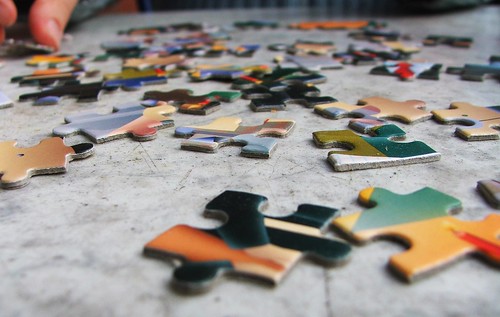
It’s been a few years since I’ve done a jigsaw puzzle. But last month my youngest asked me to sit down with her and work on a small one that she got for Christmas.

This puzzle was of a horse wearing a Native American blanket. We went through all of the standard techniques for building a puzzle. First I propped up the box lid so we could see the picture that it was supposed to look like when it was finished. Then we proceeded to flip all of the pieces so that the picture side is up and the raw cardboard side was down. Next I started sorting out all of the pieces that had a flat side, assuming that these would be the border pieces. Ideally, in the process we’d find the four corner pieces. Then the two of us started sorting the pieces by color, trying to group the pieces into smaller groups to work on separately; horse, sky, grass, blanket, etc.

Next came the process of assembly. Each of us would pick up a piece and try to see how it fit into other sections that we’d already assembled. I started by looking at the picture and trying to establish the border. I don’t always start with the border but it seemed to work for this puzzle. Sometimes it’s easier to start with a predominant color and try to get it together first and then work in the border later. I don’t really have a preference as to which method I choose. It just depends on the puzzle.

Eventually you’ll end up with a few sections assembled but not linked together. At this point you start looking for pieces that have a little bit of two different things on it, pieces that could conceivably go into more than one pile. The pieces with a little grass and a little bit of horse help tie those together and the pieces with the grass and sky help defiant he horizon. The “ah ha” moments of most puzzles come when you can link two large parts together with just a few small pieces or sometimes with just one. The best pieces are the ones that help tie three different chunks together. Once you’ve linked them you start looking for support pieces that also connect those chucks. Those help reinforce that your linking pieces are correct. Sometimes they disconfirm and force you to look for new ways to link the puzzle together.

At some point it seems you are always stuck with a bunch of pieces of relatively the same color and your only clue as to how they need to be assembled is to look at the shape of the pieces themselves and try to make them work.

Using these methods we were able to assemble this 200 piece puzzle in about 15 or 20 minutes. It struck me that in order to assemble it we had to make several assumptions about the puzzle.

1. The picture on the puzzle is the same as the picture on the box. I’ve put puzzles together without the box just to see how much longer it would take. If I had to guess it’d take at least twice as long. I’ve also participated in a team building exercise where the puzzle was put into the wrong box with a similar but just different enough image n the outside.

2. The pieces only have images on one side and raw cardboard on the other. I have actually done a puzzle that had images on both sides, but the stamping process made for edges that were easy to determine which side of the piece was for image one and which was for image two.

3. Flat edges are for the border. It’d be really sneaky to see a puzzle that had a jagged edge to the image and flat pieces that but up together inside the body of the puzzle.

4. The completed puzzle has no missing pieces in the body. We’ve all been in the situation where we’ve lost one piece and we just don’t feel like we’ve finished it.

5. All of the pieces have to be used. Want to really throw your head for a loop? Throw in a few pieces from another puzzle just to spice things up. I remember doing a puzzle and my grandmother’s house and having exactly that problem. She’d found a few pieces on the floor and just threw them into the first box she found.

I can think of several more assumptions that we make when we try to make sense of the scrambled pieces in front of us. But this will do to start out with.

Lately I've been working on a puzzle that seems to violate all of these assumptions.
No picture on the outside of the box. No raw side to the puzzle and no obvious way to tell one side from the other. Flat edges in the middle and bumpy edges on the edges. A few holes in the main body. A few extra pieces from other puzzles.
And the coup de gras of the whole puzzle is that I have a few large chunks of the puzzle that don’t even attach to each other.

Anyway, that’s my little analogy for today. I think I stopped talking about jigsaw puzzles a few paragraphs ago.
Monday, February 01, 2010

Introspection

A few years ago a celebrity got a DUI and while he was being arrested he slipped into an anti-Semitic rant. In his apology he acknowledged that he had an alcohol problem and blamed the anti-Semitic comments on the alcohol. I don’t believe that is how it actually works. The alcohol may have turned off some of his filtering software but the ideas were still there, inside him, just waiting to come forth once the filters were weakened. I felt then that this celebrity needed to not only address his alcohol problem but he also needs to confront what caused him to harbor those ideas in the first place. I trust him when he says he’s making good on correcting both problems.
Now here’s where this post gets personal. For some reason I don’t quite understand I haven’t been getting hardly any sleep for the last week or so. I don’t feel overly worn out in the mornings. It’s just weird that I just seemed to lie around and wait for the alarm to go off. I’ve just been writing it off to having too much to worry about.
Anyway a couple of times lately I’ve been a little punchy and let some comments slip that I really wish I hadn’t said. But that’s not what bothers me. Like the celebrity’s anti-Semitic comments my comments had to come from somewhere. That’s what’s bugging me. I need to go back to the drawing board on these areas of my life and re-evaluate what I value and try to figure out why those ideas were even in my head in the first place. It’s simply unacceptable to blame this on my lack of sleep. It was easy for me to criticize the celebrity and I’d be a hypocrite to try to use the same logic he did to avoid facing the real problem.
I know I have quite a bit of work to do to become the person I’d like to be. This just kinda hit me out of left field and from and area that I thought I already had taken care of.

Thursday, January 14, 2010

The Peltzman Effect

Yesterday I listened to a podcast that talked a little bit about the Peltzman Effect. In simplest terms the Peltzman Effect is a theory that claims that the safer people believe they are the more likely they are to engage in risky behavior. I need to do more reading on this but the topic seemed to confirm my own observations. From what little I’ve read this is primarily an economic theory. If you believe that your investments are insured to a certain amount you’ll take more risks than if they were not. I’ve also seen many manifestations of this in other areas. Do high-wire walkers take more chances if they have a net? Increase the safety of cars by adding anti-lock brakes and massive crumple zones and some people take this as permission to bump draft on the highway like it’s a Nascar race. In my own experience I can think of several examples from the years when I used to do much more rock climbing. I did much more dangerous things on top-rope that I ever would have done on lead. And I took much more risks on lead that I ever would consider without a rope.
It seems that the appearance of removing the risk, even if it’s only marginally safer makes people behave disproportionately to the added benefit of the safety net. The net effect seems to be that people feel even more detached from the consequences of their decisions. The safety nets, the ropes, and the ABS brakes may actually encourage more risk taking and be less safe.
I’ve given this issue a lot of thought lately for many reasons. I’ve been considering getting my VW bus on the road again and it has no ABS brakes and the crumple zone is pretty much the driver’s and passenger’s legs. I’ve been trying to get in shape to do more rock climbing than I have in years past. But the biggest reason I’ve chosen to blog about this today comes from just being a father.
It’s natural to want to pad the sharp edges that you bumped into as a kid so your kids won’t have to learn the hard way. I also try hard to provide a decent financial safety net for my children. But I fear that in a small way I may be experiencing a little bit of the Peltzman Effect. By making things a little nicer for my kids than I had it I seem to be encouraging them to take risks that I would not have taken. I made a lot of stupid mistakes as a child. I wasn’t shielded from the consequences and in most cases felt the full brunt of those mistakes. As a parent it’s much easier said than done.
There’s a British sci-fi comedy that I really love, Red Dwarf. I think sci-fi allows you to explore ideas and themes that you really couldn’t explore in other formats. In one episode one of the main characters met his alter ego from a parallel dimension. In one dimension this character, Rimmer, was a sniveling middle management suck up with no loyalty and was inept and virtually friendless. In another dimension the same person had become, Ace, the dashing space pilot that everybody wanted to be around and was the hero of everything that he attempted. The two tried to figure out at what point in their life their paths took such drastically different paths, one becoming Rimmer and the other becoming Ace. They concluded that many years ago one of them cheated on a test and got caught, the other did not. The ironic thing is that Ace was the one that got caught and Rimmer had gotten away with it. Having that wake up call early in his life had caused Ace to sit up and re-evaluate what his life would become while Rimmer never had such a wake up call.
My fear is that I’m doing too much to interfere with the natural consequences and not letting my kids get the wake up call they need. As a parent who wants only the best for them that’s much easier said than done.

Wednesday, January 06, 2010

Vigilant Realism

A few weeks ago Victoria pulled me aside to watch and interview with Barbara Ehrenreich on The Daily Show. Bright-sided: How the Relentless Promotion of Positive Thinking Has Undermined America. A few years ago Ehrenreich was diagnosed with breast cancer. She was overwhelmed with well meaning people telling her to avoid any negative emotions and to stay positive. She began to look deeper into this cult like attitude that so many people have that you can jinx your health, relationships, and your carrier if you don’t always keep a positive attitude.
Not many of us enjoy being around a cynic all the time. Don’t mistake Ehrenreich’s criticism of the giddy optimism promoted by so many as cynicism. It isn’t. She merely points out that being unrealistic about things can be far worse than just the occasion outward sign of frustration of negativity.
Last month while reading Emotional Awareness the Dalai Lama and Paul Ekman pointed out that optimism can be just as destructive as pessimism if it prevents us from seeing events as they really are. Ehrenreich builds on this theme and shows case after case where people have been deluded by their own optimism. She goes in dept to point out how destructive this mindset can be. Blinded by optimism we set reason and rational reactions aside.
This book pulled from and added to many of the books and issues that I’ve been studying for the last few years. She tackled many of the peddlers of irrational optimism like, Oprah, Rick Warren, Joel Olsten, Zig Ziglar and many others.
Unfortunately we live in a time when a book that is literally about nothing more than wishful thinking is a best seller and celebrities and actors are seen as authorities on just about any topic just because they can share a personal anecdote. I’m sorry a personal anecdote is where science starts, not where it ends. Just because Suzanne Summers feels better after a colonic doesn’t make it science and foregoing real treatments can kill you with or without a positive attitude.
I really enjoyed seeing a book that was so passionately pro-science and anti-magical thinking get such good press. I couldn’t put it down.

“A vigilant realism does not foreclose the pursuit of happiness. In fact, it makes it possible.” Barbara Ehrenreich

Thursday, December 17, 2009

Emotional Awareness


I have long been a fan of the Dalai Lama. Even though I don’t accept the deeper doctrines of Buddhism, like karma and reincarnation, I really admire the efforts that he has put in to teaching people to live more peaceably with each other. His optimism is infectious. I’ve also been a fan of the work of Dr. Paul Ekman. So it has been really enjoyable to have my commutes filled with their voices as I’ve been listening to Emotional Awareness: Overcoming the Obstacles to Psychological Balance and Compassion: A Conversation Between the Dalai Lama and Paul Ekman.
Ekman and the Dalai Lama both have the same goals but they are approaching them from different perspectives. Ekman is the scientist who is studying emotion scientifically with the goal of trying to make people’s lives better. The Dalai Lama is a spiritual leader who is also trying to make people’s lives better. Both have found a very common ground in the study of emotion and how to respond to our emotions.
I have so many things to take away from this book that I don’t really know where to start.
Much of the conversation focuses on just being aware of our own emotions and controlling what we feel and how we respond to that emotion. The Buddhist principles of compassion and mindfulness come into play quite a bit in this area.
Ekman refuses to classify emotions as positive or negative. It is only our response to that emotion that can receive such a value judgment. Fear that prompts us to get out of the way of an oncoming train can be good. But fear used to intimidate is bad. Similarly pride and anger can also have similar positive effects if channeled constructively. The only emotion that both the Dalai Lama and Ekman agree has no positive effects is contempt.
Moods are a different issue and both men agree. Moods poison the well and last longer than emotion. Most emotions only last for a relatively short time. Moods however skew you perception and are never constructive. A cranky mood will cause you to misinterpret the actions of others to fit your preconceptions. Even a good mood can be destructive if it causes you to gloss over and not give due attention to a stimulus. I found it very interesting that The Dalai Lama agreed that being overly optimistic can have similar negative effects to being overly pessimistic.
The biggest take away I have found from this book is simply an awareness. I’ve been trying to identify my feelings as emotions or as moods and then trying to consciously decide how to respond. I have a bad habit of taking tidbits that I’ve learned and educating my family. That I believe is good but I tend to sound like I’m lecturing them. I hope that as I learn better emotional awareness I will also become better at sharing with my family.

Monday, November 02, 2009

Self-Motivation

As a father I’ve been giving a lot of thought to the inherent paradox of compelled self-motivation. I want my kids to perform well in all of their pursuits. However I don’t want to have to hound them constantly in order for them to do that. The goal is that doing good and feeling good about their own accomplishments becomes the goal and not just keeping me off of their backs. If the latter is the goal what can they expect if I’m not there to encourage them? Yet if former is the goal they will just be good for goodness sake. The accomplishment remains the goal and not just fear of dad’s reprisals if they don’t accomplish the goal.
I have a problem with being more than a little too introspective. I personalize the problem and try to see where I might have set, or am setting a bad example for them. Not to deflect responsibility from my kids for their grades, however I feel that I may have been setting a bad example for them. Specifically in the area of completing a task and not giving excuses I think I’ve been setting the wrong example.
A few years ago we started a project to remodel the house. It needed an awful lot of work. The largest of the projects was to replace the siding and redo the kitchen cabinets. For the most part we got the tasks completed and they look nice. But we quickly ran out of money and time. The deck is still unfinished. The front of the house could use some shutters. The stairs are still carpeted in spite of the fact that the rest of the house has been replaced with hardwood floors. I still need to fix a new top on some bookcases installed a couple months ago and there are several little picky problems throughout the house, a power outlet that doesn’t work, a dripping faucet, a door handle that falls off, etc. etc.
I have good excuses for most of the problems. We ran out of money. I don’t have the right tool. The weather is too wet, to hot or too cold. I’m too busy this weekend. I don’t have enough room to work. Just to name a few. But these are all just excuses. I’m a hypocrite. I wouldn’t allow my kids to give me a line of excuses to justify their performance in school, scouts, or any of their activities. Yet I have my own litany of reasons and excuses to justify my shortcomings. And to top it off they live in a house that reminds them every day of the many things that I have failed to complete.
I don’t have a reasonable ETA for getting all of these tasks completed but I need to hold myself to the same expectations that I require of the kids. I’ll start with the ones that present a safety concern. Follow those with the ones that cost the least amount of money to remedy and work up to the ones that with take more time and effort. However I’ve put off correcting them for too long and now I fear that it is more than just my house that is suffering.

Sunday, October 11, 2009

another Kewl quote

"Be not the slave of your own past. Plunge into the sublime seas, dive deep and swim far, so you shall come back with self-respect, with new power, with an advanced experience that shall explain and overlook the old."
Ralph Waldo Emerson

Thursday, August 27, 2009

More on Confirmation Bias

For a few months I’ve been doing my best to lose a little bit of weight. I’ve basically just been eating smaller potions and walking on my lunch hours. The biggest motivator that I have is that my new office has a small workout room with a scale. I’ve made it a habit of starting the day off by checking my weight and recording it. In order to make sure that my results are meaningful I always measure under the same conditions. It’s always dressed for work at 6:45am and having only had a small breakfast. I even make sure that I don’t have my phone or any change in my pockets to be sure that the results aren’t artificially skewed.

Tuesday I had something to do after work and I didn’t want to show up in my AT&T uniform so I wore a nicer shirt and some different shoes. As I walked to the scale I realized that the results may not be accurate. I didn’t know if my outfit was heavier or lighter than what I usually wear. Just before I stepped on the scale I recognized that I was about to fall victim to my own confirmation bias. If the scale had read a little lighter than the day before I was ready to accept that as evidence of my diet and exercise was working. However, I was also fully ready to accept that if I was a little heavier that it was not my fault, it’s the differences in my wardrobe. As soon as I realized this I refused to step on the scale.

I bring this up again because lately I’ve seen far too many examples of people accepting information that supports their opinions and then wholesale rejecting any evidence that goes against it. Comments on blogs that accuse the blogger of a political bias while ignoring posts on the same blog that are highly critical of the same party. Family members who accept that a quack treatment works based on one example while ignoring the multiple times the same treatment did not make them feel better. Church friends using archaeological evidence to support their belief in the Book of Mormon but refusing to even read counter evidence.

It’s natural to cling to what makes us comfortable. Unfortunately it may not be the best thing to do. You’re not going to get accurate results if you can’t accept all of the evidence. If that’s the attitude that you have when you approach an issue just do as I did. Don’t even step on the scale. Same holds true on any other issue. Be aware of your biases and do your best to make sure they don’t influence your decisions.