Monday, May 12, 2008

Barr? Libertarian?

So as if our current election cycle isn't weird enough, Bob Barr has now announced that he is going to try to be the Libertarian party candidate. I will allow anybody to change their opinions on any issue. But this just smacks of political opportunism. Barr's voting record shows a blatant disregard for personal liberties. His actions show that he is economically and socially conservative. His campaign against John Linder a few years ago also shows that he will do whatever it takes to stay in power.
It'll take more than putting an L after your name for me to believe that you've changed Bob.

Miller hits the mark again

Non Sequitor by Wiley Miller

More on Parables

I seem to have a problem with parables. I'm never quite sure to which character I'm supposed to relate. For years I had a problem with the parable of the Prodigal's Son. I kept relating to much to wrong brother.
In our deacon's quorum lesson yesterday a friend of mine taught a great lesson on forgiveness. The lesson book had a story about a group of people that were hiking in Arizona. One of the hikers gets bitten by a rattlesnake. The rest decide to hunt down and kill the snake. In the mean time the victim hasn't been treated and the poison is infiltrating her leg. By the time her friends come back with the dead snake her leg is so bad that it eventually had to be amputated. Their act of vengeance against the snake had cost their friend her leg. If they had focused on treating the problem, rather that revenge, her leg may have been saved.
I recognize the desired perspective of the story is that we look through the eyes of one of the friends. How should I respond when I am given a choice between helping another and seeking revenge. If they had forgiven the snake the problem would have not been allowed to reach the point of losing a limb.
Now comes my perspective problem. After a little thinking I found myself relating to the girl who lost her leg. I've been in situations before where something happened beyond my control and I suffered the results of the inaction or mis-action of others.
I've also been in a few situations where I was the snake. Although I may have done something wrong from the hiker's perspective I was just protecting myself and now I can't seem to get a break.
The intended lesson of forgiveness is not lost on me. I can just see a lot of value in trying to relate to all of the characters in parables and not just the prime character.

Saturday, May 10, 2008

Friday, May 09, 2008

Science Project

My 13-year old son is home-schooled. Last week he started a science experiment of his own design. He decided to test a few of the additives that people put into fresh flowers to make them stay fresh longer. The protocol consisted of filling 4 identical glasses with 8 ounces of water at the same temperature. One glass was left alone as a control. The second glass had 1 tablespoon of sugar added. The next had two aspirins added. And in the last we added one packet of the plant food that came with the flowers. Into each glass we placed one small flower, with the stems cut to the same length. All the glasses we placed in the window sill in the kitchen.
I thought he'd come up with a pretty good protocol and I was looking forward to seeing his results. Well a week went by and all four of the flowers showed no real change. My son was a little upset. He wondered what had gone wrong and wanted to start over rather than write up his conclusions. I took advantage of this teaching moment to explain that he needs to complete his observations and turn in the report. I them explained that this is probably how 99% of all science experiments end. Astronomers don't find new asteroids every time the look into the sky. Research doctors don't see measurable effects of new drugs every day. Even though Aaron's experiment did not product the effect that he wanted he still had learned something. As his experiment was designed ,5 days is not enough time to measure any difference in the effect of the chemicals being tested. Although mundane this is important information that future researchers could use to improve their experiments. Aaron agreed and is currently writing up his conclusions.
Science is sometimes victim to publication bias. Like Aaron they are hesitant to publish studies that don't have dramatic results. Dramatic or not the results are still science and those result should be published. Personally, I think that there is just as much value in a study that says "Acupuncture does not have a measurable effect on pain under controlled tests" is just as valuable as a study that say, "An aspirin a day will lower your chance of a heart attack". Both give me concrete practical data that I can use to live a better life.
I probably took Aaron's report a little more personally than I should have. When I was in High School I worked with my father, a CDC microbiologist, on a science project. I hypothesized that military labs would be less accurate than civilian labs in testing for certain diseases. I took data from all over the world that had already been collected and just analyzed it in a way nobody had thought of before. My dad was really excited for me and even thought that I'd win the science fair. I got an "Honorable Mention". One of the judges said that I should have actually done some of the lab work myself for better marks. Never mind that I had a sample size of several thousand lab tests, she didn't think it was science because I used a computer rather than a test tube. Another said it would have been more impressive if I hadn't disproven my hypothesis. He actually suggested that I should have rewritten my initial hypothesis so it looked I had successfully predicted the result. Not only did I find this suggestion unethical it is not what real science is all about. In the long run I didn't walk away felling like my project was a failure. I learned that there is no statistical difference in the ability of military labs to detect certain diseases or civilian labs' ability to detect the same diseases.
My dad eventually took my report and got it published in Morbidity and Mortality Weekly Report, a peer reviewed science journal. That meant more to me than the "Honorable Mention" from my science teachers.

Monday, May 05, 2008

Turning off your brain

Suppose somebody were to ask you an interesting thought provoking question. If you were willing to have an open minded discussion about the issue both sides might learns something and at the very least you could have a stimulating discussion. I enjoy these types of discussions even if we never come to anything that resembles an answer. It's just fun to ponder the things that we don't quite understand.
Now suppose that every time an interesting question was asked you simply redefined the subject as something that does not require and answer. Well there goes any kind of discussion.
Q: What color is that book?
A: That book does not require a color.
Q: How fast is that car?
A: It is, by definition, speedless.
Q: What time is it?
A: Time is irrelevant.
You see what I mean? Granted these are just silly examples, but all to frequently people apply this same linguistically hopscotch to avoid interesting questions. Over the weekend I was mass CC'ed on an email that answered the question, "Who created God?" The answer given: "God does not require a creator." Huh? What kind of an answer is that? It isn't an answer at all. It's simply defining your subject as something that does not require and answer. This isn't a new concept. This is Aristotle's Cosmological argument just put into simpler English and distributed by email rather than toga clad sages.
What bothers me about this type of an argument is the finality of it. There's nothing left to think about. It's over. The discussion has stopped. Just when we get close to an interesting discussion they simply define the argument as out of bounds. Technically this is a form of the special pleading logical fallacy. If you have to make special exceptions to your subject that you wouldn't allow for other subjects, in this case the well establish concept of cause and effect, then your argument is fallacious. I guess I don't fault them too much. Some people are just more comfortable with concrete truths. I'd just rather have an open-minded discussion.

Busy busy busy

I opened up Firefox yesterday and it opened up to my blog, which hadn't been updated since Tuesday. At first I was a little discouraged that I hadn't done a better job of keeping it updated. I've had an awful lot of things happen in my life in the last week that I needed to blog about. But that is also the reason I hadn't gotten around to blogging. On Wednesday I had to take Rachel to Activitiy Days at church before I taught the scouts CPR. Which wasn't so bad except that Victoria had run off to the zoo with Noah on an overnight field trip. So I had to keep track of the girls while I was teaching scouts as well. Fortunately Rachel and Eve tagged up with Sadie Tayler and Mackenzie Beach and played clue.
Thursday I had to run Eve over to Granny Sue's so she could take her to school. I took a half a day off of work since I had to continue gathering materials and preparing for my Wilderness Survival course. Victoria got home just in time to start packing to go away again on Friday. It was her Birthday but we really didn't have time to celebrate.
Friday I took the day off again to finish all the preparations for my class and to just take it easy before my weekend adventure. I had to assist Aaron with his studies. After that we ran to Bass Pro shops and the fire marshalls to pickup a few last items and to get permission for our fire at the church. We bumped into Jeff Foxworthy at Bass Pro.
Victoria left around 2:00 to pick up a bunch of girl scouts and take them away for the weekend. So again I was going to be a single parent for a few days. I finished packing the car and as soon as Noah got off the bus we headed over to start setting up for my merit badge class. Granny Sue came by around 6:30 to again help out with the kids while I did what I had on my schedule.
The merit badge clinic went very well. I didn't have too many boys show up. I was worried that the group would be so large that it'd be unmanagable. I got a little bit of push back for limiting the class size but in the end nobody challenged it and - was even complimented for doing it. My biggest suprise of the day was during our fire making class. Two of the boys were very deticated to the idea of making fire with two sticks using the bow and spindle method. After about a half an hour of experimentation they actually made it work.
Victoria will be home in a few hours. I really miss her. The kids have actually been very well behaved, but it's just a busy schedule. I always knew that she worked hard and that just being a mom was a big duty. It's humbling to have to do her job and mine every now and then just to get a perspective change.
I got an email while I was camping with the scouts. Aparently there has been a little bit of a shake up at work and I will have a different boss when I show up tomorrow. Ch-ch-changes.

Monday, April 28, 2008

Horizons

There is a common theme that has been popping its head up lately. It seems that in many of the conversations I've been having lately I've been dealing with people who have a limited horizon. The things that are right in front of them so skew their perspective that they react as if those immediate things are the only things that are real. Once this topic came up in the context of evolution and another time it came up in reference to global warming. In both of these cases and in others I find that I tend to give more credence to the position that has a broader horizon.
This analogy is not mine. It's one that has been brought up in a few of the books that I've been reading. We are slaves to the middle world. Humans have a hard time dealing with the really big and the really small. So we tend to think that the more familiar things are more real. Its hard for us to understand the microscopic units of time like nanoseconds. It is just as hard for us to understand the macroscopic concept of the universe being 4.6 billion years old. It's just too hard for us to comprehend. So, it's not surprising that people revert to the more comfortable age of the universe of 6000 years. It's within our limited horizon.
There are a few people here on this Earth who still think that the world is flat. This is because their horizon is limited. What they can see appears flat so they think that applies to what they can't see as well. The Earth is not flat. All we need to do to see this is to step back, or in this case up, from the situation just a little bit. All too often we allow our emotional response to what is immediately before our eyes to cause us to to interpret our perception as absolute fact.
This same argument follows for the idea of global warming. If we just look at the recent trends we can make claims that it isn't happening, that it is happening but it's not caused by man, or even that humans putting carbon into the air is good for the planet. All of these arguments are based on limited horizons. Without stepping back and seeing the big picture it's hard to see the long term trend.
One of the tough parts about basing my opinions on logic, facts and reason is that occasionally the facts are going to confront my opinions and force an uncomfortable dilemma. Do I stick to my a priori opinions or do adjust them to meet the facts? It's not easy to make these adjustments, but as tough as it is I prefer it to dogma.
A case in point for me is the claim that nuclear weapons have made the world safer. I despise the idea of warfare in general and nuclear weapons specifically. I believe they are anathema to how people should be treating each other and solving their disagreements. A few years ago I read a claim that the percentage of deaths due to warfare has gone dramatically down since 1945. Many use this as evidence that Nuclear weapons have brought more peace than they have destruction. My gut instinct is to reject his data but the evidence is pretty compelling. If I expand my horizon beyond the immediate gut reaction the facts will be allowed to speak for themselves.
I really wish that those who confront me about my opinions would have a similar approach to accepting fact without ideological requirements and just judging the facts themselves.
For the record, I still despise warfare and think that eventually we should be able to deal peacefully with each other without such crude tools. It's still uncomfortable to admit some of the facts but, I don't try to deny them.
Tuesday, April 22, 2008

Choices

There is a phrase that I hear people use all too frequently that I have serious mixed emotions about. "We are nothing more and nothing less than the sum of our choices."
This has become a mantra for conservative talk show hosts. Neal Boortz uses it frequently to criticize those on welfare and those "looking for a hand out". For the most part I agree with the sentiment when people are indeed victims of their own bad decision making. I have little sympathy for folks who try to separate their decisions from the consequences. If you choose wisely you should expect the consequences of those decisions. Conversely if you make bad decisions you should expect to be rewarded accordingly. To this extent I have been trying to teach my children that they have the freedom to behave as they like. They just need to remember that consequences are just the other end of that decision and they can't be separated.
So I totally agree that our lives are directly affected by our decisions. My problem with the phrase comes with all encompassing and exclusionary tone of "nothing more and nothing less". This I flatly disagree with. Yesterday we heard this from the pulpit from a couple who had just returned from a mission in Spain. Granted he was trying to teach us to make correct decisions. However, as he said that I started looking around the room and one after the other I saw examples of people who were clearly more than the sum of their decisions. There was a man in front of me who is autistic. When did he choose to be autistic? Yet it is clearly part of who he is today. I saw a few little girls who had been adopted from China. When did they choose to be female and Chinese and when did they choose to be adopted? I saw a man who is still recovering from a brain tumor and will likely not return to his former brain function. Again, when did he choose this?
I fear that in their zeal to promote individual responsibility those who make this statement go too far. Denying that there are some things just outside of our control tends to deny that people can be victims. That is simply not true. Rather than blame their situations on their own behavior perhaps we should look to ways to both alleviate their current situation and also teach them how to make better decisions in the first place. In the cases that I've stated here there really was no bad decision in the first place and I see no reason to blame them for their situation.
In the Sermon on the Mount Jesus started by feeding everybody with the loaves and the fishes. I wonder how many folks would have stayed around to listen if he had just said, "You are nothing more and nothing less than the sum of our choices. The reason you are hungry now is because you decided not to bring any food." Somehow I don't think his message would have been quite as well received.

Friday, April 18, 2008

How We Believe

I originally posted this two years ago. Recently my thoughts and opinions on this issue have been called into question. So I'm reposting it.

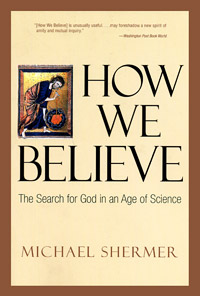
My review of How We Believe: The Search for God in an Age of Science by Michael Shermer.

One of the deepest and most spiritual books that I have every read.

This book is written from the unique perspective of a born again Christian who loses that faith and becomes the editor of Skeptic magazine. However; unlike many skeptics he has no grudge against religion, he only seeks to understand it. Unlike most scientists and religious faithful he does not try to make one disprove the other. He has found a way that they can both peacefully co-exist.

Shermer describes three different ways that people think that science and religion are related.
First, The belief that science and religion are competitive, that one will disprove the other. I think that most people fall into this category.
Second, The belief that science and religion are harmonious. I think that many LDS members fall into this category. They want to believe that the natural laws and the physical evidence will all somehow support the gospel. James E. Talmadge obvious believed this way. "Within the gospel of Jesus Christ there is room and place for every truth thus far learned by man or yet to be made known."
The problem with both of these views is that they do serious damage to both science and religion. Any attempt to interject faith into science goe s against reason. Conversely trying to discount or prove matters of faith using science is a no win situation. Once something becomes provable then, by definition, it is no longer a matter of faith.
Shermer presents us with a third option. Science and religion exist in completely different spheres. Science exists in the realm of reason and religion exists in the realm of faith. As long as we respect the role that each has to play then there is no conflict and also no need to try to make them harmonize either. "O, ye of little faith. Why do ye need science to prove God? You do not. These scientific proofs of God are not only an insult to science; to those who are deeply religious they are an insult to God."p.123
I believe that for years I have been stuck on the second level but very uncomfortable with the conflict and inconsistencies that I was seeing in trying to make it all work out. This book has inspired me to stop trying and just deal with the fact that they are not even meant to be harmonized.